Performance Details


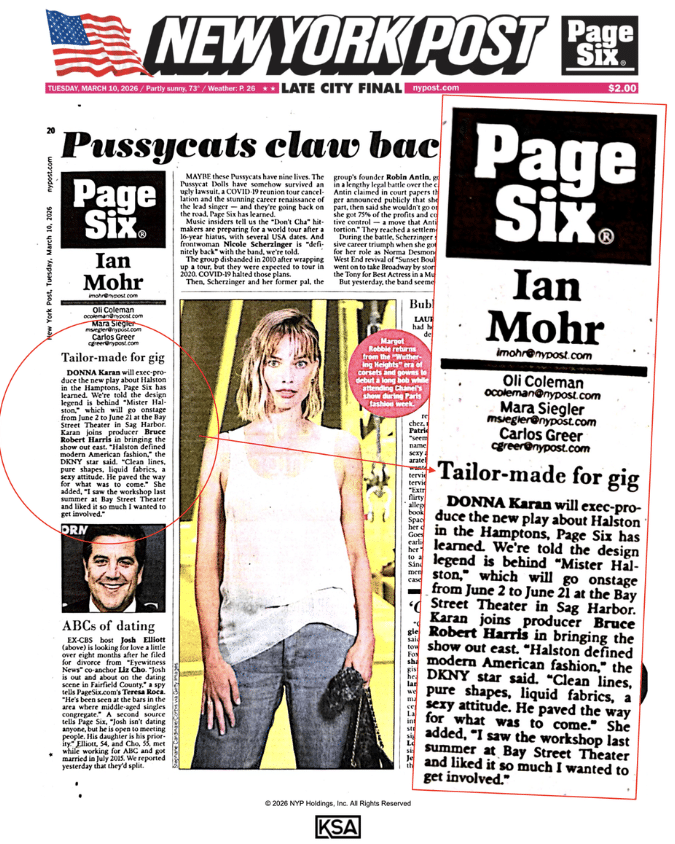
Produced in association with Tony Award–winning producer Bruce Robert Harris. Executive Producer: Donna Karan.
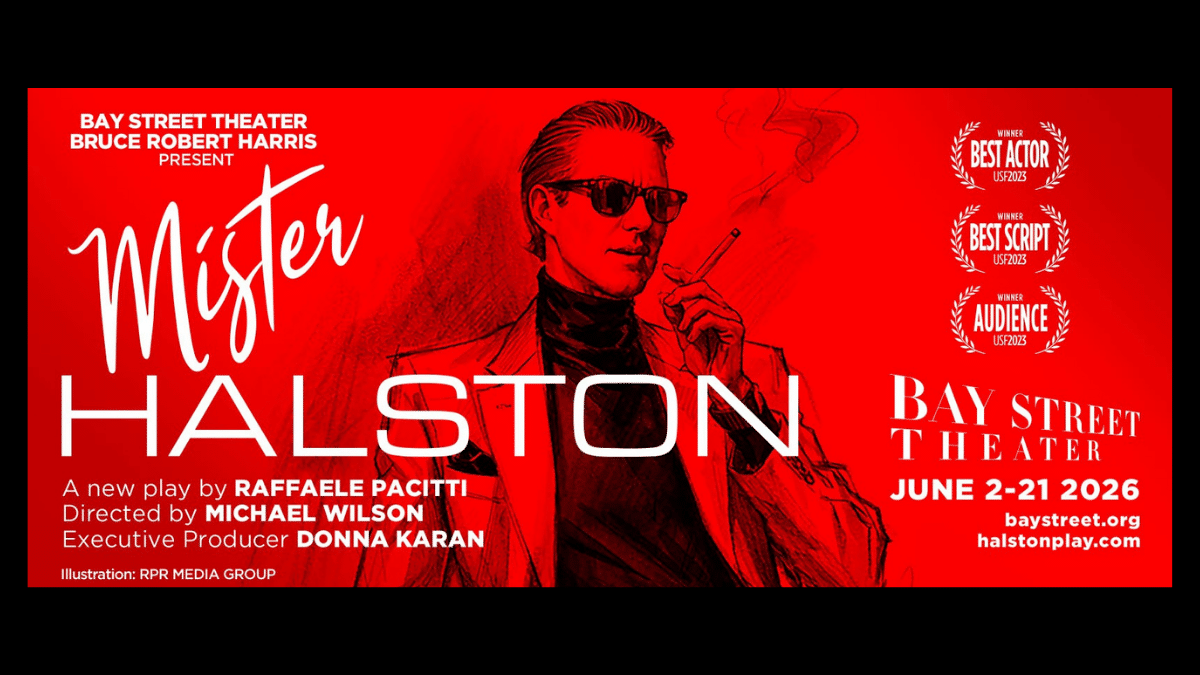
Set against the glamorous and volatile worlds of 1970s and 80s New York and directed by Michael Wilson (Bay Street’s GREY GARDENS and FELLOW TRAVELERS), Mister Halston explores the meteoric rise, stunning fame, and ultimate fall of iconic American fashion designer Halston. In Bay Street’s intimate theater, the production offers a revealing portrait of the man behind the myth, stripping away spectacle to examine the human cost of ambition, artistry, and reinvention.
*Recommended for ages 13 and older. This production contains adult themes, drug use, and strong language.
This show is sponsored by Penelope Moore, Real Estate Broker.
Performance Details
Playwright
Director
Set Designer
Costume Designer
Lighting and Projection Designer
Sound Designer/Original Music
Production Stage Manager
Assistant Stage Manager
Casting

Times Square Chronicles
Mister Halston: The Man Who Dressed America Faces Himself
“Matt McGrath doesn’t play Halston. He becomes him.”
Fashion icon, celebrity, visionary, narcissist, survivor and victim. In Raffaele Pacitti’s beautifully crafted Mister Halston, all of these versions of the legendary designer collide during a fictionalized 1987 interview that finds Halston confronting the life he built just as it begins slipping beyond his control.
At the center of this mesmerizing production is Matt McGrath, delivering one of the finest performances of the season. From the moment he enters, McGrath inhabits Halston with effortless sophistication, capturing both the swagger of a man who once ruled fashion and the fear of a man desperately trying to maintain control as his empire crumbles around him. At times he is almost Shakespearean—a Hamlet draped in cashmere and fame—projecting confidence while quietly unraveling beneath the surface.
As the interview unfolds, the audience watches a man desperately clinging to the mythology he created. The red telephone that punctuates the evening becomes almost a harbinger of doom, interrupting the conversation like a reminder that time is running out. Liza Minnelli worries. Lovers disappoint. Lawyers reveal uncomfortable truths. Halston continues performing Halston, even as the walls begin to close in.
What gives the play its emotional weight is the knowledge that hangs over every moment. Halston would die just a few years later at the age of 57 from complications related to AIDS. The audience carries that knowledge even when Halston refuses to fully acknowledge it himself. Every phone call, every memory, every attempt to control the narrative feels haunted by a future that is rapidly approaching. McGrath allows flashes of fear and vulnerability to emerge beneath Halston’s carefully constructed armor, revealing a man who understands far more than he is willing to admit.
McGrath’s achievement lies in his ability to reveal the contradictions that made Halston so fascinating. He is charismatic and infuriating. Brilliant and self-destructive. Vulnerable and fiercely guarded. The performance never asks us to excuse him, only to understand him. By the evening’s end, we are not simply watching a fashion designer. We are witnessing a man confronting his own mortality while refusing to surrender the spotlight.
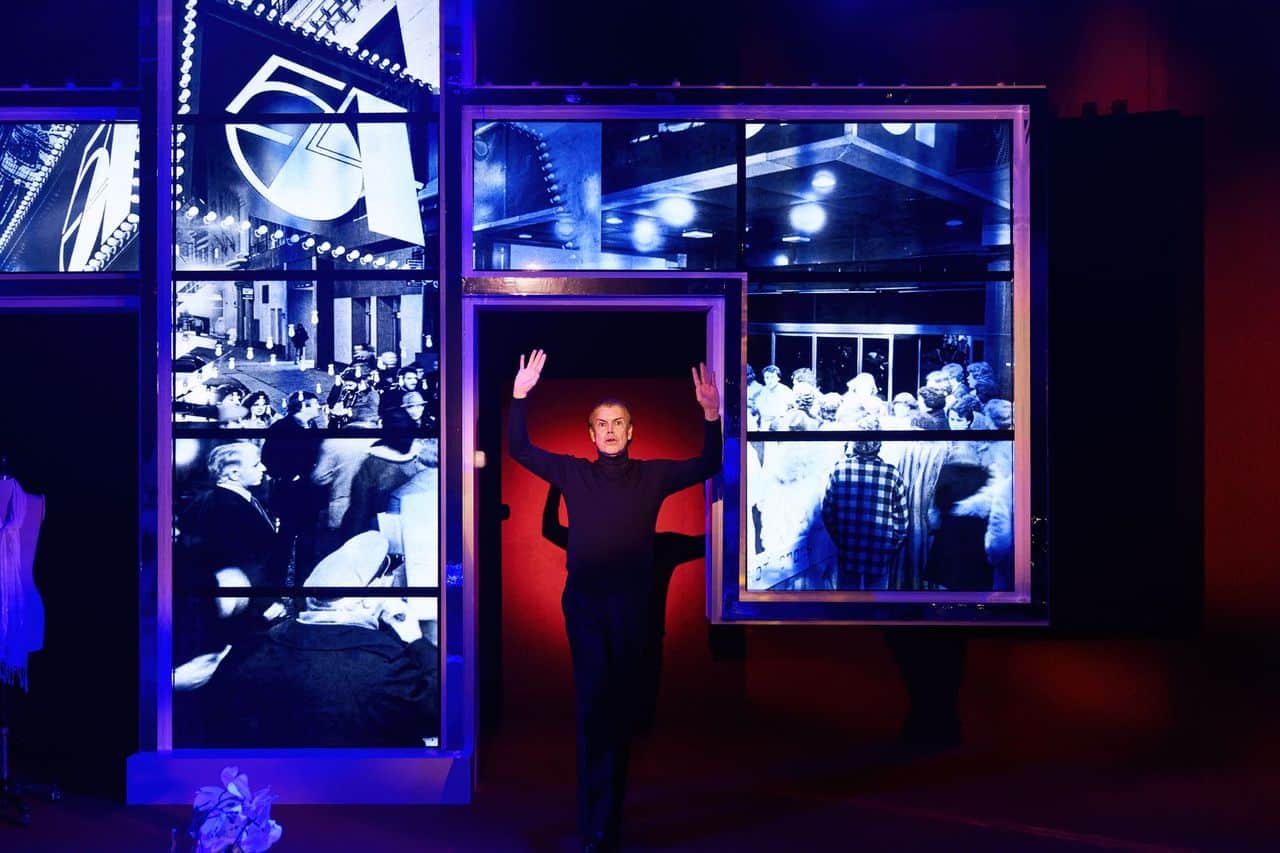
What elevates Mister Halston beyond a biographical portrait is its vivid recreation of a cultural landscape that no longer exists. Through Halston’s recollections, the audience revisits a New York defined by glamour, excess, celebrity, artistic freedom, and reinvention. We encounter the world of Studio 54, the rise of celebrity culture, shifting conversations surrounding identity and sexuality, and the devastating shadow cast by the AIDS epidemic. Halston becomes both the man and the era itself—a symbol of a moment when New York believed anything was possible and paid a tremendous price for that freedom.
Director Michael Wilson, building upon the original direction by Kimberly Senior, creates a production that is both intimate and emotionally devastating. James Noone’s striking set design bathes Halston’s world in decadent shades of red, while David C. Woolard’s costumes, Mike Billings’ lighting and projections, and John Gromada’s evocative sound design create an atmosphere that feels simultaneously glamorous and haunted.
Produced in association with Tony Award-winning producer Bruce Robert Harris and Executive Producer Donna Karan, Mister Halston is more than a portrait of a designer. It is a quintessential New York story about ambition, reinvention, celebrity, excess, and the steep price of becoming a legend while still alive.
Most importantly, it belongs in New York.
If Bay Street is smart, this won’t be Halston’s final fitting.
Mister Halston: Bay Street Theatre, 1 Long Wharf, Sag Harbor, NY until June 21st
Hamptons.com
Title: Review: “Mister Halston” Triumphantly Opens at Bay Street Theater
Article:
There was a lot of buzz before the World Premiere official opening Saturday night of Mister Halston at the Bay Street Theater. It is Bay Street Theater’s first show of the season. Matt McGrath is riveting as Mister Halston. His performance is gripping and powerful, a must-see. The enthusiastic standing ovation at the conclusion validated the pre-show buzz and points to a very successful run of Mister Halston playing now through June 21. The show was introduced to the audience by Artistic Director Scott Schwartz and Executive Director Tracy Mitchell.
Mister Halston is written by Raffaele Pacitti and brilliantly directed by Michael Wilson and produced by Bay Street Theater, Bruce Robert Thomas, with Donna Karan as Executive Producer.
Seeing this show is important for several cultural reasons. Besides shining a bright light on an important figure during a cultural shift in the 1970s through the 1980s, it verbally documents, live on stage, the salient moments that propelled a change in fashion branding. Matt McGrath brings the essence of Halston to life with magnificent panache. Director Michael Wilson has him dashing around the stage like a caged panther, ready to pounce, while also revealing vulnerabilities and delivering touching yet biting humor with sharp wit. Mr. McGrath brings Halston back to flamboyant life right there on the iconic Bay Street stage.
There is an important narrative between the lines of this show. Halston was a proud gay man and stood tall and took some hurtful incoming flak because of that. That underlying theme is both brilliantly woven into the show and portrayed live in real time on stage by Matt McGrath. Then there is the actual colorful story of how Roy Halston Frowick became mononymously known as Halston, the person Newsweek crowned “the premier designer of all America.” The name-dropping in the show adds a certain accent to it and to the way things were pre-internet, TikTok, and Instagram. The scene with the fabric falling from the ceiling is memorable, effective, and, perhaps, award-winning.
It takes a village of talent to produce a one-man show successfully. For this production of Mister Halston, one must start with the Lighting/Projection Designer Mike Billings. Mr. Billings is a proven talent and once again validates his reputation by skillfully lighting this show. Sometimes softly, sometimes suddenly, but always effectively, Mr. Billings’ projections and pointed lighting added to this production.
Scenic Designer James Noone’s brilliant set is a sea of daring red, which helps punctuate Mr. McGrath’s stage presence. Costume Designer David Woolard has Matt McGrath looking very Halston.
John Gromada effectively handles the Sound/Original Music. Kudos to Production Stage Manager Bob Bennett and to Assistant Stage Manager Denise Yaney.
For ticket information and show schedule, visit: www.baystreet.org
Theatre Life
Matt McGrath Brings a Fashion Legend’s Life to the Stage in Mister Halston
McGrath stars in Bay Street Theater’s new play about the iconic designer.
By Brian Scott Lipton
Hamptons | June 10, 2026
While the life of Roy Halston Frowick wasn’t exactly a Horatio Alger story, it’s definitely a tale of rising to the top from humble beginnings. Halston, as he eventually became known, scaled the ladders of fashion to become one of the most famous designers in the world. His success granted him high social status as well. He became a regular at Studio 54 and had close friendships with Liza Minnelli, Elizabeth Taylor, and Andy Warhol, among other superstars. Sadly, neither fame nor fortune stopped the spread of an AIDS-related cancer that ended Halston’s life in 1990 at the age of 57.
While Halston’s life has been told in a variety of mediums, his story has come to the stage at Sag Harbor’s Bay Street Theater in Raffaele Picciti’s solo play Mister Halston, directed by Michael Wilson and starring Matt McGrath as the legendary designer.
Intriguingly, the more salacious aspects of Halston’s life did not particularly interest the show’s main producer Bruce Robert Harris: “I wanted to produce this play because I wanted to tell this important story about an iconic figure in the design world who changed women’s fashions forever and his influence on the way we dress and today’s designers, as well as how his fashion empire was ultimately destroyed,” he says.
While McGrath never actually met Halston, the actor, who began his Broadway career at age 8 in the 1978 musical Working, knew about him as both a designer and a social personality from his adolescence.
“I started going out to clubs in New York City at age 15, and finding myself in rooms with people like Debbie Harry, Andy Warhol, Keith Haring, and maybe even Halston, but I never met him,” recalls McGrath. “In addition, from a young age, I loved reading fashion magazines and I was always fascinated with the clothes. Of course, I had to admire them from afar. I wasn’t buying sixteen-hundred-dollar ensembles in those days.”
McGrath, who came onto the project in recent months, had less time than he might have liked to research the role, but he’s found plenty of outside resources. “First and foremost, Raffaele is a font of knowledge,” he says. “He has friends who knew Halston and everyone has plenty of anecdotes. Of course, I read Steven Gaines’s seminal biography, Simply Halston. I watched some CNN documentaries about him, and I watched the documentary, UltraSuede: In Search of Halston. It’s all been very informative.”
Among the things McGrath learned is that Halston ultimately lost the right to use his own name on his own designs through a series of unforeseen corporate deals. The play contains numerous scenes where Halston is frantically talking to his unseen lawyer about making a deal with Revlon to reclaim it, which ultimately fails.
“It’s a cautionary tale about the dangers of not protecting your work, which is true of artists of all types,” he says. “You can never be sure how things will go awry. But at the end of the day, he taught so many people, like jewelry designer Elsa Perretti, how to transform from being artist to becoming a successful businessperson. I think the moral of the story is, no matter what, talent and hard work always win out.”
McGrath also readily admits that for all the role’s challenges, it also fits into his theatrical wheelhouse, which has included such larger-than-life roles as Hedwig, the Emcee in Cabaret, and Harold in The Boys in the Band.
“While I am generally more soft-spoken and unassuming in real life, I love a role that’s a heavy lift because it makes you stronger as an actor,” he says. “I feel you do what feeds you as an artist, and roles like this allow you to say a lot in every sense of the word. I am honored to have been given this opportunity.”
Dan’s Papers
Title: Bay Street Theater ‘Mister Halston’ Finds Fabulousness & Pathos in Designer’s Life
Author: Marc Horowitz
Article:
Bay Street Theater ‘Mister Halston’ Finds Fabulousness & Pathos in Designer’s Life
By Marc Horowitz
At the height of his powers, there was no one more fabulous than Halston.
With apologies to Ralph Lauren, Calvin Klein, Diane von Furstenberg and other fashion industry titans, Halston occupied a rarefied perch as arguably the most influential American designer of the 20th century.
Effortlessly chic, Halston’s aesthetic helped define not only the visual style of the 1970s, but also the zeitgeist of the era. Liza Minnelli was his BFF, he shared a lover with Andy Warhol, and Studio 54 in its decadent heyday was his personal playground.
By doing what appeared to come naturally, working tirelessly and partying just as hard, Halston almost singlehandedly invented the idea of fashionista as celebrity. In fact, he was one of the first designers to transform himself into a brand, extending his influence through fragrances, mass-market licensing deals and a carefully cultivated, impossibly glamorous public persona.
Written by Raffaele Pacitti, directed by Michael Wilson and starring Matt McGrath, Bay Street Theater’s world premiere production of Mister Halston delivers an electric and moving portrait of the fashion icon during the final chapters of his remarkable life.
It’s 1987. We’re in Halston’s legendary Upper East Side townhouse. Still formidable, but firmly middle-aged and definitely not in perfect health, Halston greets a young writer for The New York Times who has come to the townhouse to profile him. Since this is a one-man show and McGrath plays only a single role, the unseen, unheard writer character serves as a stand-in for the audience, allowing Halston to address us directly. It’s an effective piece of scenography that plays particularly well in a small theater like Bay Street.
Given that this production appears to have aspirations that extend beyond its first-ever staging in the Hamptons, aspirations that might take it, say, 100 miles or so to the west, it will be interesting to see how the unseen writer device might play in a larger, less intimate venue.
When we meet Halston in his townhouse, he’s in his mid-50s and already beginning to feel the effects of the AIDS virus which would ultimately take his life three years later. But this is not a man on his death bed.
He’s huffing cocaine, swilling booze from Baccarat crystal and stomping around the stage. One moment he’s threatening the writer and ferociously angry as he screams at his lawyer on the telephone, then he’s nostalgic and reflective, even seductive. And at times, when he’s at his most human, he’s just world weary and beaten down. Regret has rendered him almost unrecognizable, a shadow of the Halston everyone of a certain age thinks they know.
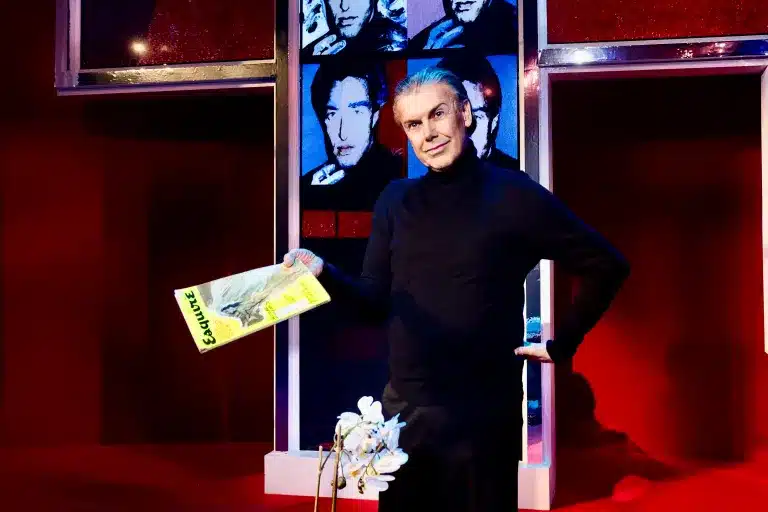
Like Halston’s creations, scenic designer James Noone’s townhouse set is bold and tasteful, but also relatively spare, except for a series of video screens asymmetrically arrayed against the back stage wall. Wilson and his team make very good use of the screens as the narrative progresses.
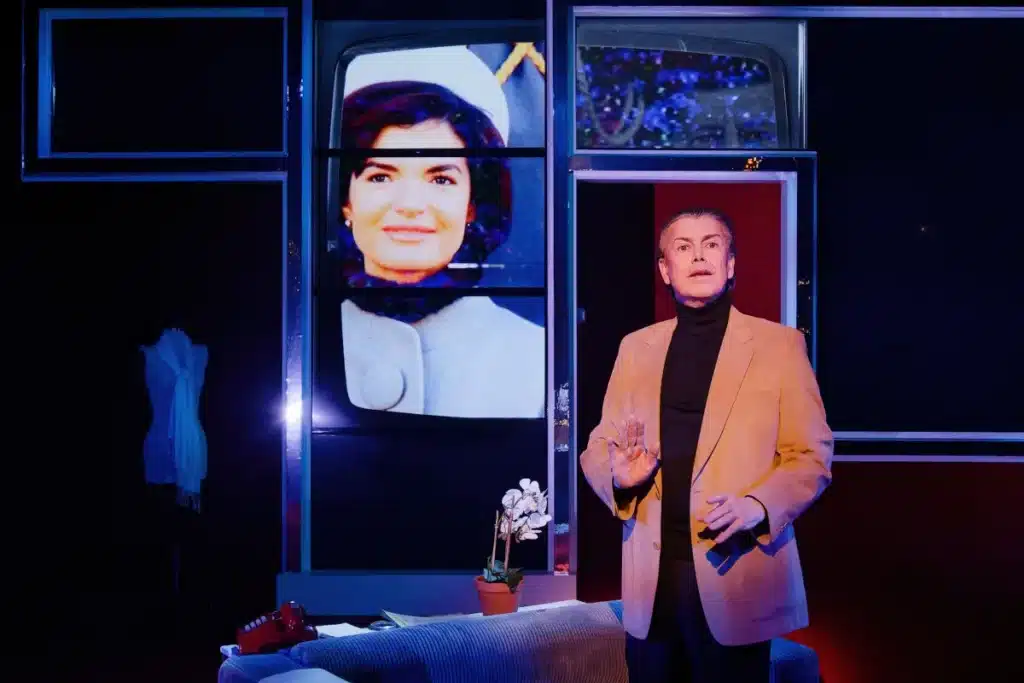
A few carefully placed white orchids, the designer’s signature flower, provide just a bit of welcome contrast to the deep, resplendent red tones of the set. An old school touch-tone telephone, also in red, not only serves as a vital prop, but also positively screams ‘late-80s.’
Aided and abetted by powerful imagery on the video screens, McGrath dips in and out of key moments from Halston’s personal and professional history, including his formative years when Roy Halston Frowick, a not-so-naive midwestern boy, came to New York and gradually conquered the upper echelons of the city’s fashion culture.
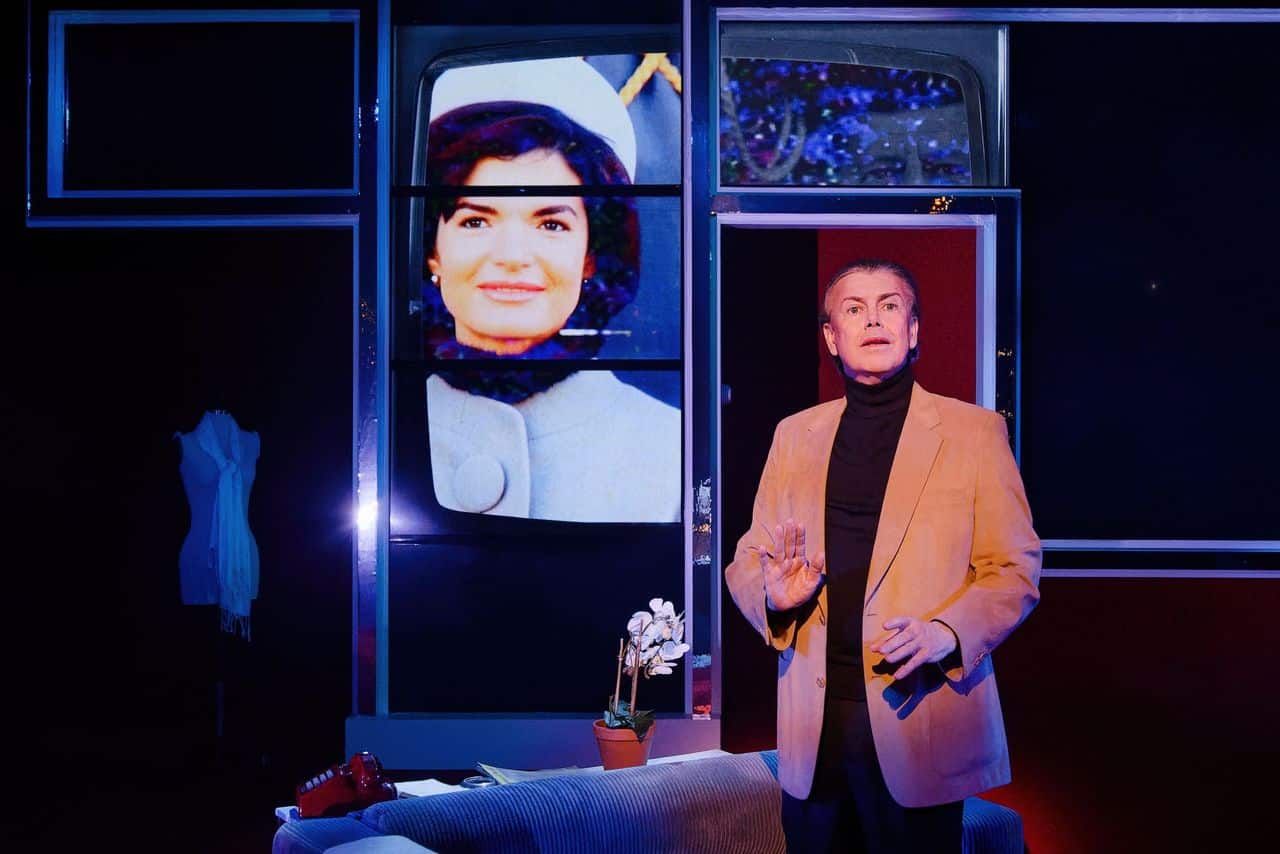
Before he became a legendary clothing designer, Halston was an in-house milliner at Bergdorf Goodman. An early signature moment, which McGrath brings beautifully to life, came when Jacqueline Kennedy Onassis asked Halston to design a hat for her to wear to President Kennedy’s inauguration in 1961. Halston, who was 29 at the time, created the pillbox hat that became an instant fashion classic on that windy day in Washington D.C.
McGrath clearly embraces the inherent peril and potential glory of carrying a one-man show. He doesn’t seem to be playing Halston, he positively inhabits the man. He nails the designer’s seemingly endless confidence and faith in his own vision, but also the haunting insecurity that bubbles just below the surface.
While he obviously had a vibrant inner life, Halston was a person who fixated on facades. Long before the social media era changed the game, he recognized that you don’t create a billion-dollar fashion brand without focusing relentlessly on image-building. Pacitti’s trenchant script makes that clear, and McGrath consistently shows the audience what it looks like.
Listen to the timbre and cadence of his voice change, how he ratchets up the campiness, when he talks to Liza Minnelli on the red phone. Watch the desperate ways he attempts to bully the Times profile writer, first via fire and brimstone, then via flattery, into writing his piece exactly as Halston wishes it to be written.
McGrath and Wilson create several exceptionally involving set pieces. In one, Halston recounts the inspiration that led him to create the iconic watercolor chiffon dress Lauren Hutton wore to the 1975 Academy Awards.
As swaths of fabric fall from the rafters, Halston catches them in mid-air and arrays them on a dressmaker’s dummy while presenting a running commentary on the inspiration behind the design. Meanwhile the video screens flash shots of the gown itself and Hutton wearing it. It’s an absolutely thrilling piece of staging.
Ultimately, Mister Halston doles out the fabulousness and the pathos in almost equal measure. As it probably had to, the story ends on a plaintive note, reminding us that no matter how incandescent it may be at its pinnacle, fame has a shelf life.
Halston laments having sold his name and personal brand to the mass market retailer JC Penney, albeit for a staggering amount of money. As he schemes with his lawyer to regain control of his design legacy, the conversation feels less like a workable plan and more like a cry for help.
“They will need me again,” he says of the industry that made him a fashion superstar. But as the curtain falls, neither he nor the audience has a reason to believe that.
Publication: Sag Harbor Express and 27east
Title: Mister Halston
There was a glorious time in the latter quarter of the last century when Manhattan was a place that literal dreams could come true, especially for boys with creative flair from small, midwestern cities where their talents were underappreciated by their brethren.
Well, perhaps it still can happen that way, but the way it happened in the 1970s somehow seemed simpler, purer and a lot more fun.
Opening the mainstage season at Bay Street Theater this month is “Mister Halston,” the world premiere of a brilliantly insightful one-man show written by Raffaele Pacitti. As the title would indicate, the play explores the life, legacy and, ultimately, the languishing of an iconic American fashion designer who, when he was at the top of his game, ruled not just Manhattan, but the world. And like all shooting stars, the brightness eventually fades and the remnants fall to earth, ending a run that can’t possibly go on forever, as much as people would like it to.
That’s an apt description for the life and times of Roy Halston Frowick, who was born in Des Moines, Iowa in 1932 and ultimately became known by the singular name of Halston on the wider stage. He began his career as a milliner in Chicago and was catapulted to fame after designing the blue pillbox hat that Jackie Kennedy wore in 1961 at the presidential inauguration of her husband. Her coat and dress, by the way, were by Oleg Cassini.
When Halston expanded his label beyond hats in 1966 and began designing clothing, a whole new sophisticated segment of society took notice. Then, as the 1960s segued into the 1970s, Halston began to favor halter tops, ethereal fabrics and dresses cut on the bias for the elegant women he outfitted.
Like those he dressed, this Bay Street production is beautifully directed by Michael Wilson, while the words of Pacitti’s revealing script are enhanced by a certain sentimentality for the 1970s, which didn’t seem so great at the time but, in hindsight, look like nirvana. Credit James Noone for this provocative set, which is all New York City elegance and sass, heavily dominated by the red hues and white orchids that Halston favored.
But ultimately, this is a show that is firmly shouldered by and in the capable hands of one actor, the multi-talented Matt McGrath, who, as Halston, is a powerhouse in the role. He offers a compelling performance by inhabiting his character with deep insight and understanding, and the occasional flash of pure rage.
As the lights come up at the beginning of this one-act play, we see Halston pouting as he laments that his assistant, Mohammed, hasn’t yet lit the candles. The year is 1987 and it’s late afternoon in Halston’s living room on East 63rd Street. Halston is nervously awaiting the arrival of a New York Times reporter who is scheduled to interview him for a story. When that journalist turns out to be a “he” instead of a “she,” Halston is taken aback. He is immediately thrown off balance and on edge. This is obviously a man who values control and he now fears this interview is out of his ability to steer it.
Still, he tries. Suggesting phrasing, telling the reporter to use this word and not that one conveys an overarching anxiety on the part of Halston about how it will all come out on paper.
The device of relying on a nonexistent journalist is a clever one. It’s a mechanism that allows for the telling of Halston’s backstory without falling into the abyss of stiltedness that such exposition often brings. Despite the fact he doesn’t want to share his rags-to-riches story, Halston tells it anyway, quickly launching into the tale of his first realization of fashion as a youngster. It was in the Tea Room of a downtown Des Moines department store at a fancy luncheon, by midwestern standards anyway, when he witnessed statuesque women modeling lovely clothes for the audience. It opened young Roy’s mind to the possibilities of a fashion-filled life beyond Iowa.
We learn of Halston’s early years designing hats in Chicago, followed by his move to New York City where he began a line for Bergdorf’s. He remarks on how hats gave women currency in an era where precious little was to be had. When a woman’s hatted head turns, he notes, everyone in the room looks to see where she’s focusing her attention.
It’s a subtly astute observation, and one of several moments of candor that are highly illuminating and moving. These moments also illustrate Halston’s respect for the women for whom he designed. A poignant illustration of Halston’s philosophy came from his own statement that, “You have to design for what people are, not what you’d like them to be.”
McGrath is marvelous as Halston and inhabits the character with total conviction. The mercurial Halston is, by turns, charming, wistful, controlling and, on occasion, provoked to anger. The anger is primarily directed toward Nick, his attorney who calls frequently throughout the course of the evening to update Halston on negotiations involving an unfavorable contract with a company that is now poised to take everything, even Halston’s name.
The truth is, toward the end of his career Halston had pretty much lost it all. A deal to sell clothes through J.C. Penney was seen as a cheapening of the brand that led Bergdorf to booting him. The subsequent takeover of Penney’s by the conglomerate Esmark and, later, the hardly fashion-forward Beatrice Foods, ultimately spelled the demise of the brand.
Perhaps it was naivete or the fact that Halston had no one in his life at the time, either a partner or business manager, to help him navigate the shark-infested waters of corporate greed. It’s a sad state of affairs for a designer who was so recently flying high, and it serves as a cautionary tale for what can happen at the intersection of high-end design and aggressive corporate takeovers.
In any case, this is a production that is both stunning and evocative, highlighted by poignant touches of nostalgia that evoke longing for an earlier era. Credit for that goes to costume designer David C. Woolard, John Gromada’s sound design and original music, and the projection designs by Mike Billings that dominate the back wall of the set.
For much of the play, we are treated to Andy Warhol’s signature paintings of Halston. But there is a most poignant video sequence of Jackie Kennedy in that pillbox hat in Washington, D.C. in 1961. That hat made Halston a star and the video zooms in to freeze longingly on Jackie’s face, even as her newly inaugurated husband stands by her side. It reveals who Halston truly saw when he created his work.
From crazy nights at Studio 54, his love for his former partner, a troubled man named Victor Hugo who became one of Andy Warhol’s assistants at The Factory, to his deep and enduring friendship with Liza Minnelli, we hear it all, including a deep cough emanating from his chest. Halston swears it’s nothing, but this is the mid-80s and we all suspect what is coming.
Perhaps the most moving moment in the play comes when Halston recreates one of his crowning achievements, the pastel-hued dress that Lauren Hutton wore at the 1975 Oscars. Created from strips of chiffon in sherbet hues, it was a look fit for a Greek goddess. As Halston recalls the origin story of the various pieces of fabric, they drop magically from the ceiling all around the stage. He arranges them artfully on a dress form and, in the end, ties the fabric pieces together with a simple belt in a stunningly accurate recreation of the gown that Hutton wore that night.
It’s a surprisingly effective bit of direction. Even those not particularly knowledgeable about or interested in fashion can’t help but be moved by the way Halston shares his passion for his art. Rather than making clothes that he wanted to see on women, Halston truly saw the women who wore his designs, which, in the end, was probably one of his most endearing legacies. At a time when women were expected to be many things, but independent, free thinkers was not one of them, he elevated their stature to take a central role.
Are there surprises or twists and turns in “Mister Halston” that are entirely unexpected? Not exactly. Halston’s biography is easily accessible to anyone who’s interested in finding out the backstory. The bigger question might be: Is it worth reflecting back on a period of 20th century fashion when all things were possible with a little imagination and a bit of chiffon?
As they say in the Midwest, “You betcha.”